
By Brooke Beamesderfer, 2026 PennAg Industries Intern

Elwynn Taylor, a former extension climatologist at Iowa State University, said: “There is no culture without agriculture.” This message is more meaningful to me now than ever before.
As a farmer’s daughter in Lebanon County, I never questioned where my food came from. I understood, firsthand, the honest dedication required to feed families across our state and nation. But as I prepared to enter my senior year as an Agribusiness Management student at Penn State, I knew that I had a lot more to learn about this industry.
That realization led me to accept a summer internship with PennAg Industries Association. I wanted to step beyond the familiar world of my family’s farm and learn about the people, commodities, and policies that support Pennsylvania agriculture as a whole.
It didn’t take long to understand PennAg’s impact. In fact, I learned that lesson on my first day at the office.
Following Pennsylvania’s late-April frost, I had the opportunity to watch PennAg bring together growers, legislators, and state agriculture officials to find solutions for specialty crop producers. I had always assumed disaster declarations simply happened. Instead, I witnessed the advocacy required before relief ever reaches farmers. It was a humbling reminder that when agriculture faces unexpected challenges, people are working tirelessly behind the scenes to ensure farmers and agribusinesses have a voice. And those were the people I was surrounded by throughout my summer at PennAg.
From that first day, the tone for the rest of my internship was set as I broadened my perspective on both production and policy.
Beyond the Farm Gate
Over the next two and a half months, every visit with a PennAg member, meeting, and conversation expanded my understanding of Pennsylvania agriculture. While PennAg represents a wide variety of agribusinesses, some of the experiences that impacted me the most were surprisingly close to home. On my visit with Triple-M-Farms and Limestone Springs Fishing Preserve, I was reminded that even places I had driven past countless times held stories and processes I had never taken the time to understand.
From a personal standpoint, the experiences that meant the most were the ones that connected directly back to my own life.
Growing up on a poultry farm, I’ve always been familiar with the day-to-day side of livestock production. Learning about PennAg’s Rapid Response subcontract gave me a glimpse into the emergency side of the industry—something I hope our family farm never has to experience. Still, it deepened my appreciation and confidence in biosecurity.
I also never expected to leave a cover crop demonstration thinking about my own cut flower hobby. While I was there to gather media footage, I found myself learning alongside the growers. By the time I drove home, I was already thinking about whether I should plant wheat or rye to overwinter my dahlia field.
From orchards and fish farms to grain mills, biosecurity warehouses, and conservation field days, every stop broadened my perspective. I entered the summer believing I understood agriculture because of how I was raised. I left realizing my family’s farm had given me an incredible foundation—but it was only one piece of Pennsylvania’s much larger agricultural story.




Behind the Scenes
Before this summer, policy was something I associated with legislation and government meetings. Now, I see it differently. Policy isn’t separate from production—it shapes it. Many of the decisions made in Harrisburg and Washington, D.C., eventually reach the farm gate.
The timing of my internship couldn’t have been better. While the state budget process unfolded, I was also taking an “Introduction to American Government” summer course. What I was learning in the class came alive through my internship, and what I was experiencing through my internship gave new meaning to what I had learned in class.
One week, I was assisting with data collection for agricultural budget line items. Days later, my professor assigned a paper explaining the checks and balances of the government system. Instead of relying solely on a textbook, I found myself reflecting on conversations I had heard, meetings I had attended, and the real people affected by those decisions. Government wasn’t just something I studied—it was something I could see influencing agriculture in real time.
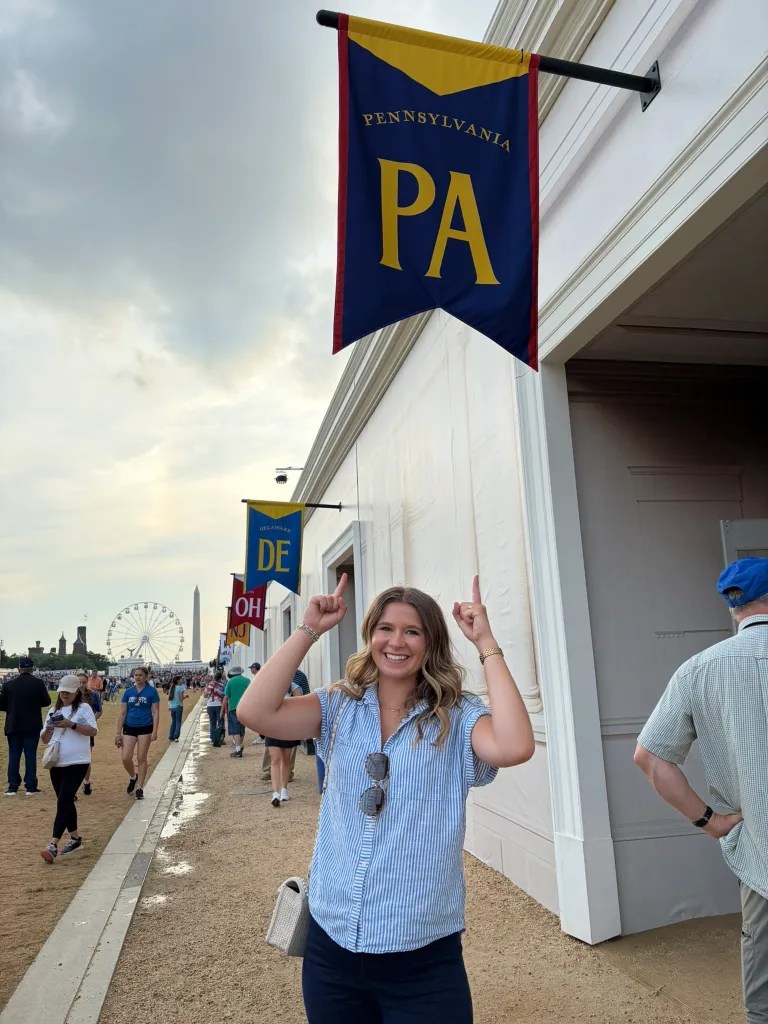
One experience, however, brought everything I had learned throughout this summer together. Attending the Great American State Fair in Washington, D.C., was a true full-circle moment.
As a longtime county fair exhibitor and former Pennsylvania State Fair Queen Alternate, I have always appreciated events that celebrate our rural heritage. This time, though, I saw those traditions through a different lens. I felt proud to be part of an organization that helped showcase Pennsylvania agriculture in a way that honored our state’s rich agricultural roots.
As our nation celebrated its 250th anniversary, I couldn’t help but reflect on how fitting it was that agriculture remained front and center of this historical yet cultural milestone. After spending the summer learning about both production and policy, I understood more clearly than ever that our nation’s history—and its future—are inseparable from agriculture.
Agriculture succeeds today because farmers, agribusinesses, researchers, educators, policymakers, and advocates all play an essential role in our society. Seeing those connections firsthand changed not only how I understand the industry, but also where I hope to make a difference within it, wherever my desired career path takes me in the future.
Looking Ahead
As my internship comes to a close, I can confidently say that I accomplished my goal of broadening my horizons – as well as so much more. One of the things I appreciated most about my time at PennAg was that no two days were ever the same. From visiting with agribusinesses and sitting in on meetings to preparing materials for upcoming events and everything in between, each experience offered a new opportunity to learn and become a more well-rounded individual.
Growing up on a farm and being heavily involved in agriculture throughout my youth laid the foundation for who I am today. This internship built upon that foundation by showing me how production and partnerships work together to keep our industry strong. Beyond gaining a deeper understanding of Pennsylvania agriculture, I developed valuable knowledge about legislative affairs, project management, marketing, and communications by working alongside every member of the PennAg team. Their willingness to share their knowledge and invest in my growth made this internship far more than just a summer job.
When I first began this internship, Elwynn Taylor’s quote, “There is no culture without agriculture,” was simply a phrase I appreciated. In fact, I printed the quote and pinned it beside my calendar in my cubicle. Today, it is a belief I have seen lived out every day. Agriculture is the foundation of our nation’s history and our future. I cannot think of a greater purpose than dedicating my career to serving an industry that has already given me so much by being a strong advocate for it in the future.